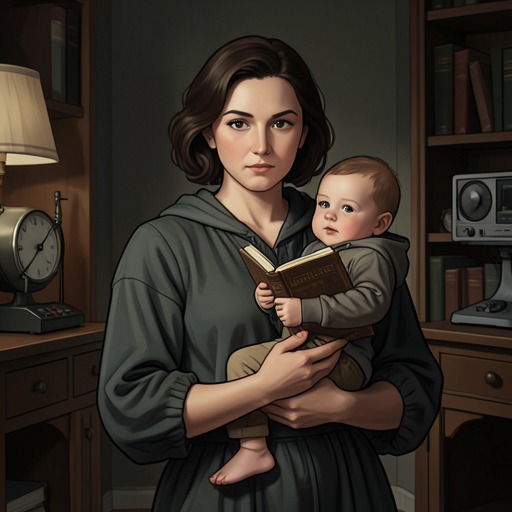
Helen Laferty
The Devil All the TimeHelen Laferty’s story turns on the gap between other people’s hopes for her and the violence that finally ends her life. Emma Russell once promised God that, if her son Willard came home alive, she would make sure he married Helen and cared for her. That promise failed when Willard married someone else, and Helen instead became Roy Laferty’s wife and Lenora’s mother. Roy later killed her in the woods while attempting to make her death into a test of faith; in the aftermath, her daughter’s prayers and visits to her grave preserve Helen’s place in the family’s memory.
Identity and Emma’s Promise
Helen enters the story through Emma’s recollection of a vow made during the uncertainty of Willard’s wartime absence. After hearing that the pallbearers doubted there was anything in the casket of Mildred Carver’s son, Emma began searching for a sign that might tell her how to keep Willard safe. Helen had recently been left alone after her family died in a house fire. Two days later, Emma knelt and promised God that, if Willard returned alive, she would see that he married Helen and looked after her.
The promise was made for Helen’s protection, but Emma had not considered what keeping it would mean in practice. When she later looked at Willard, with his dark, wavy hair and chiseled features, she regretted having tied his future to the vow. She described Helen as wearing a dirty bonnet fastened beneath her square chin and having a long face resembling her grandmother Rachel’s, whom many in Greenbrier County considered exceptionally homely. Emma’s description exposes the distance between her religious obligation and her private judgment of Helen’s appearance; it does not tell the reader how Helen saw herself.
Marriage and a Different Future
Willard’s return did not fulfill Emma’s plan. Several weeks after he left for Ohio to learn more about the waitress he had met, Helen came to Emma’s home on a warm November afternoon. Emma was rereading Willard’s letter: he and the waitress had married a week earlier, planned to remain in Ohio for the time being, and he had found work at a meatpacking plant. The news disappointed Emma’s old expectation, but Helen arrived with an announcement of her own.
Helen said Roy had asked her to marry him and had told her that God had given him a sign they were meant for each other. She wanted to tell Emma first because she knew Emma had worried about her. It was the first time Emma had seen her without a bonnet. Emma, standing with Willard’s letter in her hand, thought of the vow she had been unable to keep, then felt relief: Helen’s news seemed hopeful rather than ominous. She asked where the couple would live. Helen explained that Roy had a place behind a gas station in Topperville and that Theodore would stay with them for at least a little while. Her disclosure briefly offered Emma an alternative to the future she had tried to arrange for her son.
Marriage, Motherhood, and the Woods
Helen’s marriage to Roy did not protect her. After Roy had seemed to return to his former self and talk again about preaching, he asked Helen to leave Lenora with Emma while they went for a drive. He said they needed to get out of the house and promised that he was finished with the closet. Helen was relieved by his changed behavior. Theodore, too, had stopped going out at night, practiced religious songs, kept to coffee, and even held the baby for a few minutes, something he had never done before.
Roy drove Helen about thirty minutes to woods a few miles east of Coal Creek. Theodore came with them, riding in the back seat and pretending to sleep. The men had disagreed about whether Helen’s death should be a private moment between husband and wife: Roy wanted privacy, while Theodore insisted on witnessing the Spirit leave her so he could be sure the event was not being faked. Beneath a beech tree, Roy suggested that they pray. Helen knelt with him, believing his embrace affectionate, and turned to kiss him. Roy then plunged Theodore’s screwdriver into the side of her neck.
Helen pulled the screwdriver from the wound and tried to crawl away. She managed only a few feet before falling among the leaves. As she died, she called Lenora’s name several times. Theodore watched from the car, waited, and eventually got out. The scene makes the cost of Roy’s religious delusion concrete: Helen is not an abstraction in his private test but a wife and mother who, in her final moments, calls for the child left in Emma’s care.
Memory and Narrative Significance
Roy did not accept Helen’s death at once. Three hours later, he was still kneeling beside her body, holding her hand and trying to coax her back to life. His supplications, initially marked by faith and fervor, became increasingly garbled as her body remained motionless. The contrast between the couple’s earlier marriage proposal, framed by Roy as a divine sign, and the killing he later carried out under religious language makes the sign motif painfully unstable: belief accompanies both the promise of a shared life and the justification of a fatal act.
Helen’s life is also carried forward through Lenora, who has no memory of either parent. Lenora prays for her murdered mother’s soul and visits her grave several times a week, reading the Bible aloud, especially the Psalms that Emma had told her were Helen’s favorite part of Scripture. By the time Lenora finishes sixth grade, she knows all the Psalms by heart. Helen’s absence thus becomes an enduring presence in her daughter’s routine: the mother Lenora cannot remember is approached through prayer, scripture, and repeated visits to the grave. The narrative gives Helen little space to speak beyond her news to Emma and her calls for Lenora, but those moments establish her as more than the object of Emma’s promise or Roy’s delusion. Her marriage, motherhood, and death shape the lives and religious imaginations of those who remain.